
Story Mode Is Live: Stop Studying German. Start Living It.
Vladimir & Lingviko team
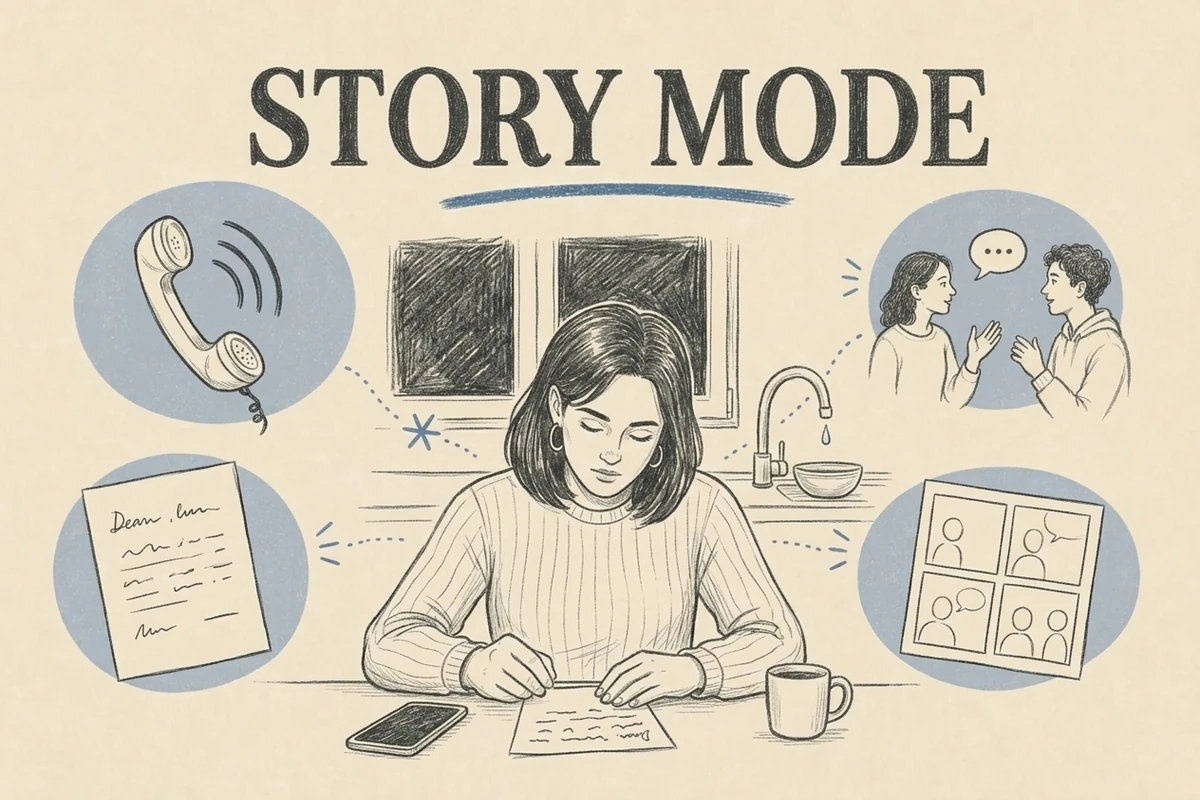
It's eleven at night. The kitchen faucet won't stop dripping, and in the morning you have to call your landlord about it in German, out loud, at his speed. Writing him would be easy; any translator will hand you a clean email in ten seconds. That stopped being the hard part years ago. On the phone, you have to understand and respond in real time: no draft, no second pass, nothing to look up while he waits. Just his voice and whatever you can find to say back. You rehearse the first sentence a few times and put the phone face down.

If you live here, you know that pause before the phone. German isn't a hobby you picked up. It can be the difference between being dismissed and being understood at the Bürgeramt, at the Ausländerbehörde, at work, or with the neighbor who guards the building's parcel key.
Today we're opening the doors on the thing we've been building toward all along. Story Mode is live. It's switched on today for every subscriber, with nothing extra to buy. The faucet call becomes an episode in a German life that is yours, with a landlord who hears your tone, neighbors who remember your name, and a story nobody wrote in advance, because you're writing it. It sits next to the honest exam benchmark we shipped first, so Story Mode and Exam Mode now work together. That connection is the part we can't stop grinning about.
Two Ways to Learn, Two Ways to Fail
Someone kept a streak going on a well-known language app for a thousand days, then froze at a food truck the first time he tried to order in Spanish. "I was not chasing fluency. I was chasing numbers."
That's the first failure: practice that's enjoyable and never measured. Streaks and points bring you back tomorrow, but they don't show what you can do. Years can pass like that.
The second failure is the opposite. Buy the prep book, grind the mock tests, memorize the templates, walk out with a score. What you've learned is the test. The clerk asks something the templates didn't cover, and you don't know how to respond.
Pick almost any tool and you're asked to choose between liking the thing and trusting that it works. We refused the trade. Story Mode is the practice, the part where you get better. Exam Mode is the measurement, the part that tells you whether you did. Both read the same profile: the words and grammar you can use under pressure. The test results then shape what you practice in the next story.
An Episode of Your German Life
Each episode has three parts, presented as situations from everyday life.
First, pieces of a German day arrive. Not exercises. Artifacts. A WhatsApp text from a neighbor. A voicemail you scribble notes from. A notice taped up in the stairwell. A page of the Berliner Nachrichten. Kleinanzeigen to sift through, a department-store directory to navigate, a colleague's email to decode. There are seventeen formats like these, all part of the story and based on formats used in the real Goethe and telc exams. You're practicing for the exam without using a worksheet.
Then you respond. You write the email with real To, Subject, and Body fields, grammar help when you need it, and the chance to revise your answer before submitting it. Or you text. Or your phone rings and you talk, live, voice to voice. No multiple choice. No picking the reply off a list. You choose the words, and your response changes what happens next.
And then the app does something we've never seen anywhere else. The screen goes quiet and says: "Let's see what your words have caused..."
About a minute later, the result of your response appears as a four-panel comic, drawn and voiced for you. It develops on screen like a Polaroid, blurry to sharp, while you wait to see how your landlord understood your message. A cold, clipped email and he shows up defensive. A warm and careful one and he's on your side. Nobody wrote that scene in advance. You wrote it, in German, at eleven at night. We call it causation, and once you've felt it, stories that ignore your choices feel unresponsive.
The People Who Remember You
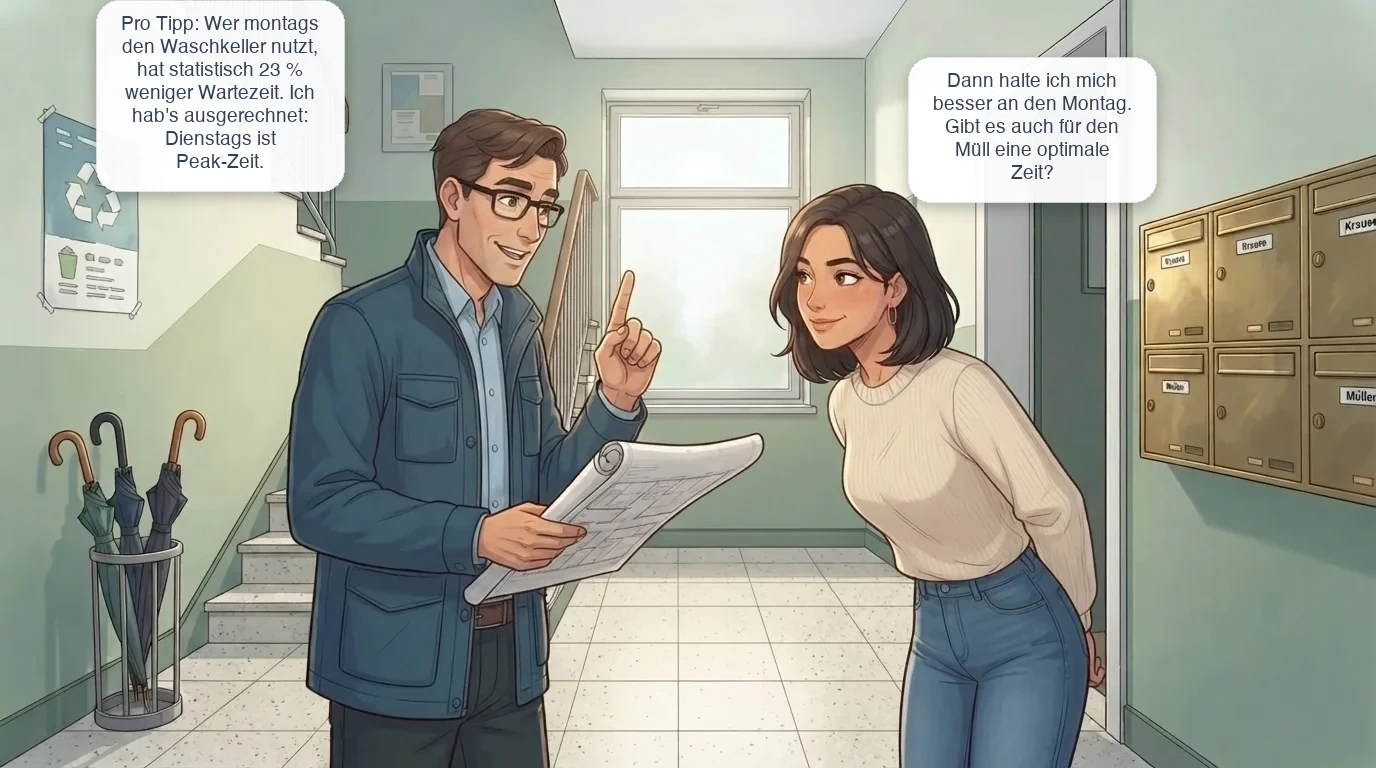
You meet three recurring characters from the first day: the keeper of your building and its Hausordnung, the neighbor who knows which Bäckerei is worth the queue, and a colleague you see throughout the workweek. They have personalities: the Overcorrector who answers a Berlin question with "Ick mach dit schon!", the Nostalgist, the Accidental Philosopher. And they have something almost no software character has ever had: a memory of you.
“Wow! It is absolutely amazing,
and there is nothing else like it
out there as far as I know.”Ben, beta user
Most apps reset every session. Lingviko's characters carry forward everything you've said. If you were curt last time, they'll remember. If you make a mistake, they won't bring it up later, but they'll notice. What you write changes the relationship. This is what turns exercises into a life: you stop performing for a grader and start managing your reputation with people. Fictional people, yes, but you still think carefully about how to phrase your next message to Frau Weber.
How Story Mode Adapts to You
Research helps explain why this approach works. Robert Bjork spent a career showing that practice that feels smooth is usually the practice that doesn't stick. He calls the comfortable version an illusion of competence. Merrill Swain found that learners improve when they have to produce the language themselves, under pressure and with a reason to care. Each episode asks you to respond at a level just beyond what you can already do.
Underneath, the engine tracks every word and grammar pattern you encounter and builds each exercise so about 92% of the words are ones you already know: enough familiar language to follow the story, with some new vocabulary to learn. Grammar you're weak in gets practiced more. Words you may be forgetting appear again in later stories, perhaps in a message from a neighbor instead of on a flashcard. And here's our favorite trick in the whole system: two or three episodes before a new structure is formally practiced, characters simply start using it in their messages. When the structure finally has a name, you've already met it in context.
Two limitations are worth mentioning. Story Mode opens at A2.1, the point where there's enough German to follow a story without having to look up every other word. Below A2.1, start with Exam Mode, which will help you reach it. This is also a beta. The loop runs and the episodes are real, but you may still find rough spots. We would rather you have it now and tell us what needs work than delay the release.
The Test That Keeps It Honest
Sooner or later the only question is whether you'd pass. Exam Mode takes the real question types from whichever CEFR certificate you're aiming at and turns your readiness into one number that moves every time you practice. A dashboard ring shows your estimated chance of passing: roughly 68% for B1, as of today. Its motto is printed right on the mode: no hints, no retries, just you and the clock.
It won't soften things. It'll tell you that listening is your weakest section or the dative is your weakest area of grammar. If your performance drops, the score drops too. A streak will congratulate you for a thousand days; the benchmark won't, for the same reason the real exam won't. Showing up doesn't move it. Getting better does. Most apps will never tell you you're not ready. We think an honest estimate is more useful than false reassurance.
The Loop
Both modes share one learner profile for a reason.
The test spots a gap. The dative, say. Because both modes read the same profile, Story Mode gives you situations that require it: someone to hand something to, someone to help out, a key that has to be given to exactly the right neighbor. The app doesn't label these situations as grammar drills. You live through one, the ring ticks upward, and the next gap shapes another story.
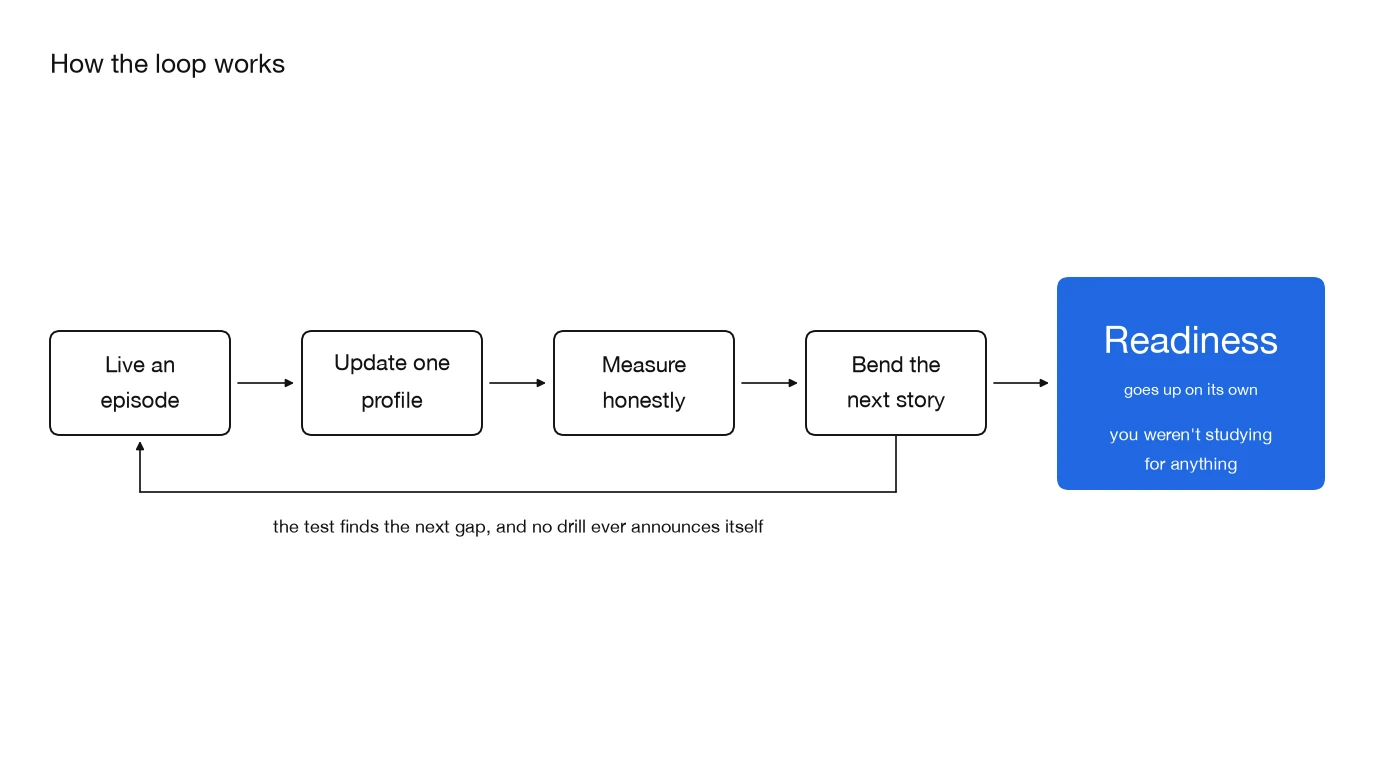
The main benefit of the shared profile is that living the stories improves your exam readiness. You weren't studying for the certificate. You were emailing the landlord, calling the plumber, and sorting out a misunderstanding with a neighbor, but each of those tasks was also preparing you for the exam.
That keeps Story Mode from becoming another "habit app that teaches as a side effect," as one gamification consultant puts it. The story brings you back, but only better German raises your readiness score.
Story Mode is live today, sitting in the app next to the test that keeps it honest, already waiting inside your subscription. Start your German life and see how your landlord responds. If you don't know your current German level, the readiness check is the place to start.
Ready to prepare for your German exam?
Lingviko is built to help you prepare for your specific exam: Goethe-Zertifikat®, telc®, or ÖSD®. Practice all four skills with instant feedback and personalized exercises.
Start preparing with Lingviko