Will I Pass My German Exam? How to Know Your Readiness Score Is Telling the Truth
·Lingviko Team
Two questions circle your head before an official German exam. The loud one: will I pass? The one that keeps you up: can I trust anything that tells me I will?
You have done the practice. An app showed you a climbing score and a green checkmark and called you ready. You did not quite believe it, because a visa, a job, a residence permit, or a family reunification rides on a single morning in an exam hall, and a checkmark is not certainty.
Your doubt is the correct instinct. The most dangerous thing a prep tool can do is make you feel ready when you are not. Here is why that happens so often, and how to tell a readiness score that is telling you the truth from one that is flattering you.
Passed the App, Failed the Exam
The failure has a shape. People describe weeks of practice that "had given me false confidence," a scoring system "handing out a sense of progress you haven't earned." They expect the result the app promised and collect a colder certificate. The exam did not get harder. The practice told them what they wanted to hear.
This is not bad luck or your fault. It is what happens when an AI tool does three things at once:
The practice is easier than the real exam. AI exercises are tuned to encourage, not to match difficulty, so the real reading and listening arrive "a lot harder than my practice materials," faster and noisier than anything you rehearsed.
The grading is inflated. Research on exams at a German university found AI awarded significantly more points than human scorers; a study grading German A-level essays found AI and human experts agreed on the final grade only about a third of the time. The number is inflated before you see it.
The feedback is generic. The Goethe-Institut warns that AI grammar tools flag corrections that are wrong or irrelevant, and learners get feedback "more like a checklist" than a verdict on whether they met the task, so it never names what will actually cost them points.
Stack the three into one number and easy practice, inflated grades, and shallow feedback collapse into a single confident "you are ready." That is why people do not just fail, they fail surprised, the kind of failure that poisons trust in every tool they used. Even happy reviewers give it away: the best they manage is hoping the questions "have a close likeness to the exam." Hope is not a measurement.
The Real Question Is Not Your Score. It Is Whether You Can Trust It.
The fix is not a kinder number. It is knowing what separates an honest score from a flattering one, so you can hold any tool, ours included, to the same test. Four questions do it. A score that cannot answer them is decoration.
1. Is it measured against the real passing line?
An honest score is anchored outside itself, to the cut-score that actually decides pass or fail for your exam at your level. A flattering one grades on a private curve, where "good enough for the app" has no fixed relationship to "good enough for the examiner." Ask what the number is measured against. A vague answer means a vague number.
2. Does it get more careful as it learns, or more cheerful?
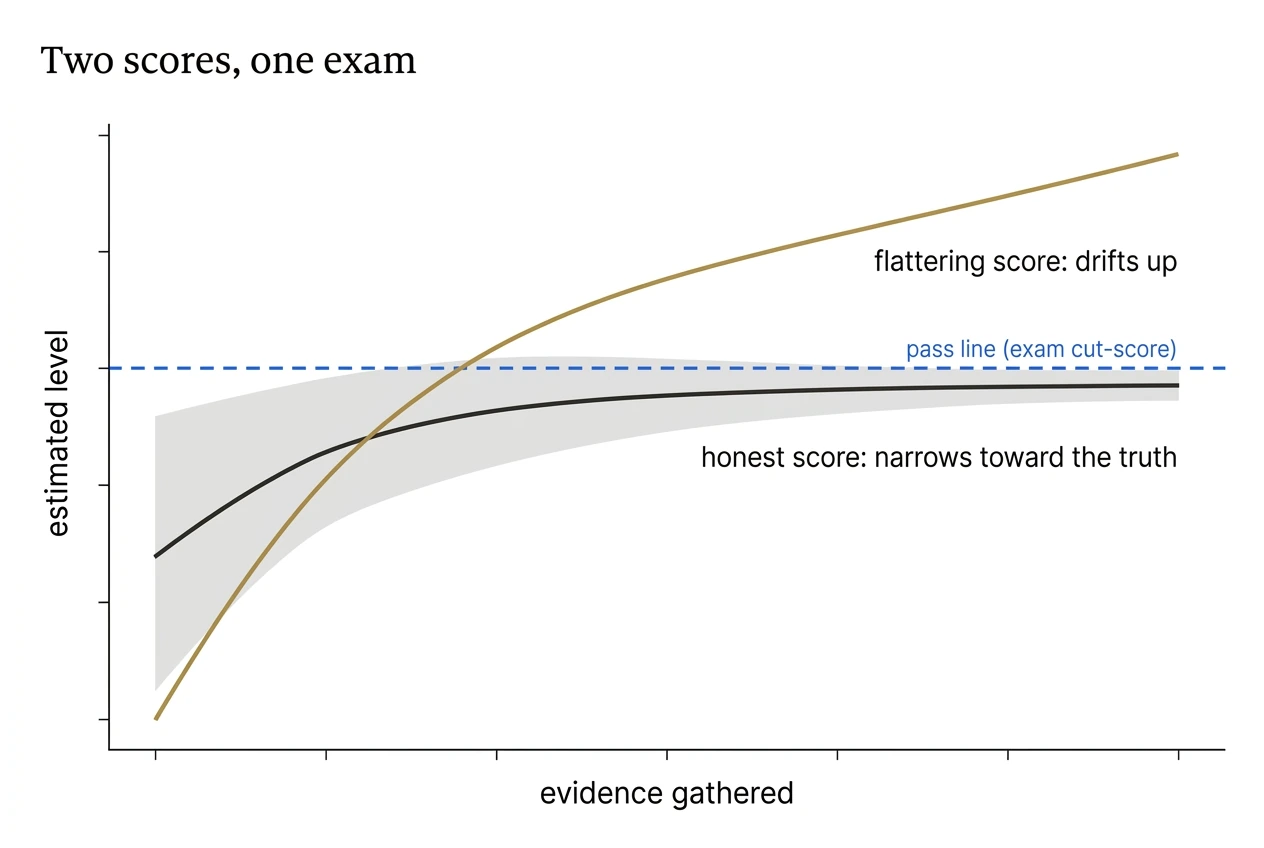
Watch what the number does as you practice. A flattering one drifts upward, because a rising score keeps you opening the app. An honest one starts cautious, because it barely knows you, and tightens toward the truth as evidence arrives. The direction of travel should be accuracy, not your mood.
3. Can it tell you why, or only what?
A number alone is a horoscope. An honest score shows its work: which sections are weak, which grammar points keep failing you, what to drill next. A tool that cannot say why it put you at a level is not measuring you, it is guessing and rounding.
4. Does it use one yardstick from start to finish?
If a tool places you at one level and its report contradicts it, neither number means anything. An honest score measures you with one consistent method from the first question to the last, so the result is something you can reason about instead of a pile of mixed signals.
How the Lingviko Readiness Score Answers Each One
We built our readiness score around these four questions, because they are the ones we would ask before trusting a number with our own exam day.
It is calibrated to the real passing line. Your score is one pass-probability number tied to the CEFR cut-score for your level, A1 through B2, across the official German exams people sit for a visa, a job, or a residence permit: Goethe, telc, and ÖSD. Given everything we have watched you do, how likely are you to clear the line examiners actually draw, in every part of the exam, not just your strongest. It is built not to flatter.
It gets sharper, not cheerier. The number is built to under-promise: a floor, the level we are at least confident you have reached, not the rosiest reading we could defend. More exercises do not lift it to please you, they narrow it toward the truth, skill by skill: each skill starts from your placement estimate, your level as read by a short opening warm-up, and tightens only on its own answers, never as one pooled number across every question. (Its technical name is a Bayesian posterior, a belief that updates on evidence rather than an average that drifts upward.)
A flattering score climbs to keep you opening the app. An honest one starts cautious and narrows toward the truth as evidence arrives. This runs for each skill on its own, not as one pooled number.
It can always tell you why. Every question is tagged to a specific skill and grammar point before you see it, so the score is built from labeled evidence, not anonymous right and wrong. The report breaks your readiness across reading, listening, writing, and speaking and names the grammar points costing you the most, so you leave knowing exactly what to fix.
It uses one yardstick throughout. The same engine measures you from your first placement question to your final report, so you never get one verdict at the start and a contradicting one at the end.
The honest limit: a calibrated probability is not a crystal ball, and no tool can promise you a pass. What it can do is refuse to lie about where you stand, and point you at the work that moves the number.
We Don't Let One Strong Skill Hide a Weak One
There is one more thing an honest score has to get right, and it is the one most tools quietly skip. Reading, listening, writing, and speaking are different skills, so we score them separately, not as one blended average. Your starting estimate comes from a short vocabulary and grammar warm-up. That is a fair clue to your level, but it cannot hear you follow fast speech or watch you write. So each skill begins from that clue and stays deliberately unsure, most unsure for the skills the warm-up never touched, and only firms up as you actually answer questions in it. A confident grammar result never stands in for a listening score you have not earned.
Your headline, the single pass-probability number, is then your weakest skill, not the average of the four. Real exams work the same way: they will not let one strong skill cover for a weak one, they split the exam into parts you must each clear on its own. Goethe, telc, and ÖSD each draw those parts a little differently by level, but they share that shape, a bar to clear in each part rather than one pooled total that a strong area can carry. An average is the flattering number, the one that blindsides people on exam day with the skill they quietly avoided. Your weakest skill decides the morning, so it is the one we put first.
The Science: Probing the Edge of What You Know
All of this, the cautious start and the per-skill narrowing, rests on one idea from the math behind the major standardized tests: Item Response Theory. A question teaches the system something only when its outcome is in doubt. One pitched far below your level you pass without thinking; one far above you miss no matter what; neither tells us anything new. The information lives at the boundary, the question poised at the edge of what you can do, where you might go either way. That is where each answer reveals the most.
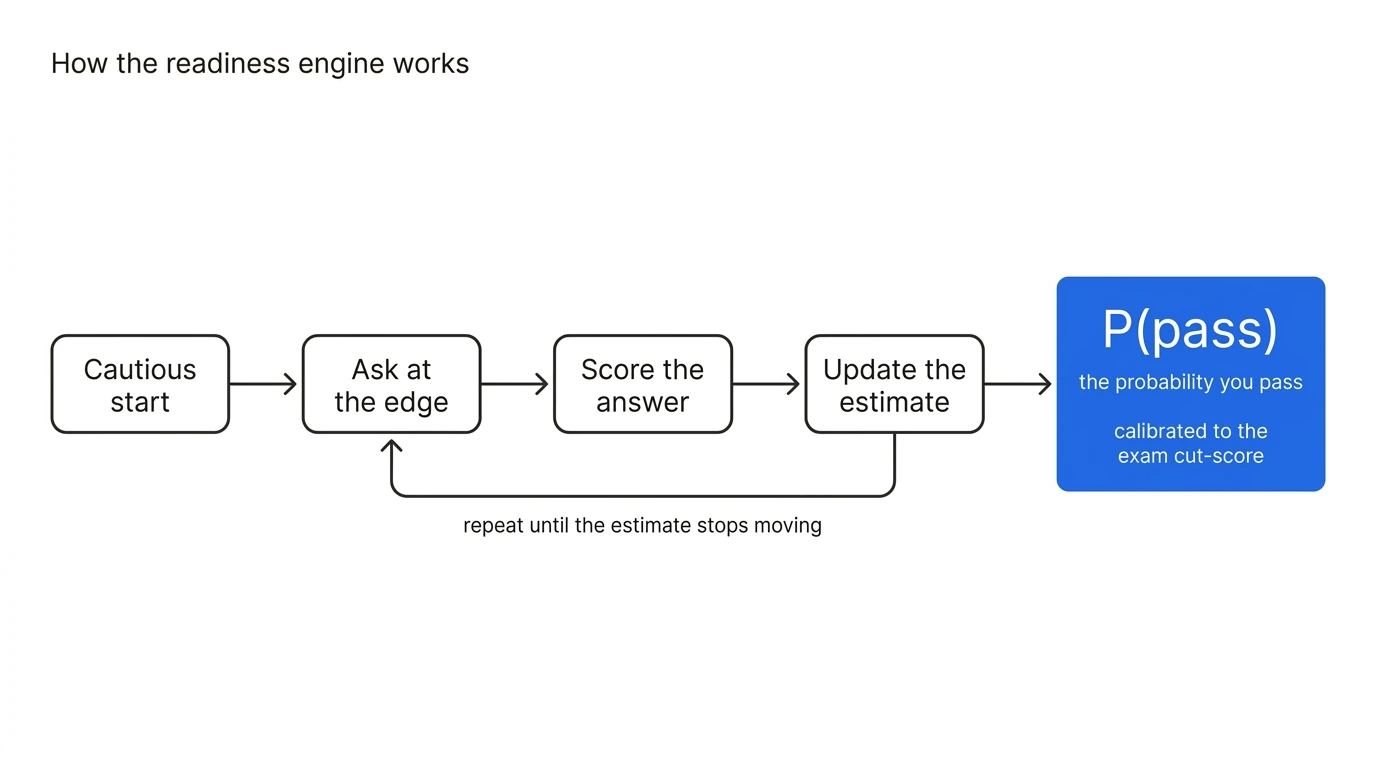
One loop runs from your first question to your final score, then reports P(pass): your probability of clearing the exam passing line, calibrated to the cut-score for your level.
So it never marches through a fixed list. After each answer it redraws its picture of your ability and asks one thing: where is the edge now, and what single question would sharpen it most? Then it asks exactly that. The edge moves as the picture sharpens, and the engine chases it, spending every question where it buys the most certainty and none on what it has already settled. That is how a short adaptive session pins your level more precisely than a long fixed test: it hunts the boundary of your knowledge and presses until the number stops moving.
A Test That Ends the Moment It Knows Enough
That stopping point is not a fixed number of questions. Every answer narrows the range you could be in. Think of an error bar around your level: wide when the engine barely knows you, tightening with each question. The session stops the instant that bar is tight enough to call your result, and no further. Near the pass-fail line it asks more, where certainty is hardest to earn; far above or below it asks less, where the answer is already plain. So no two readiness checks run the same length: each ends when it is sure about you, not when a fixed wall of questions runs out.
And it sharpens with every person who takes it. Here is the honest state today: the score is anchored to the published cut-scores and built to under-promise, and we are still gathering the real exam results that would let us publish a calibration curve: proof that when we say your chance of passing is 80%, about 80 of every 100 learners we tell that to actually pass. We are not going to pretend otherwise. What we are building is the proof itself: each real exam result we line up against the score we issued teaches the engine where the true edges sit, which grammar points are harder than they look, and how tight the error bar must be before a prediction reliably matches the real outcome. As those results accumulate we close the gap between our number and your exam result, reaching the same confidence with fewer questions and a smaller margin of error. That is the sentence every other tool skips: not "trust us," but "here is how we keep proving we are right."
Try It Before You Trust It
You do not have to take any of this on faith. On the site, with no signup, you can correct a real B1 email and watch the grammar engine repair it line by line, judge a listening clip at exam speed, and fill the one blank in a grammar sentence where exactly one answer holds up. This is the product running in your browser, not a demo reel.
When you want the real answer to "will I pass," run the Exam Readiness Check: a short adaptive session that scores you across reading, listening, writing, and speaking, sets your headline at your weakest skill instead of a flattering average, and never makes the number look better than it really is. You get one honest pass-probability score and the exact weak spots to fix, for €3.99 once, with no subscription. Better to hear the truth here, while you still have time to act on it, than on exam morning. Not a cheerful guess. A measurement you can act on.
Frequently Asked Questions
How is a readiness score different from a practice test score?
A practice-test score tells you how you did on one set of questions. A readiness score estimates how likely you are to pass the real exam, built from everything you have done and calibrated to your level's CEFR cut-score. One looks backward at a single test; the other looks forward at exam day and updates as the evidence grows.
Why does an honest readiness score sometimes look lower than the score another app gave me?
Because many tools inflate. AI has been found to grade German responses almost a full grade more generously than examiners, and its practice often runs easier than the exam. An honest score starts cautious and rises only on real evidence, so it can read lower than one engineered to feel good. A lower true number beats a higher false one: it is the one that matches what happens in the exam hall.
Which German exams does this work for?
The official German CEFR exams from A1 to B2, the levels most people need for a visa, a job, or a residence permit, including exams such as Goethe and telc. The score is calibrated to the cut-score for your target level. It does not yet cover C1 or C2.
Can a readiness score guarantee I will pass?
No, and distrust anything that claims it can. Promising a pass is the exact false confidence this article warns about. A readiness score is a calibrated probability and a map of your weak spots, not a promise. Its job is to tell you the truth about where you stand and what to work on, so exam day holds no surprise.
How often does the score update?
After every exercise, folding each new answer into the estimate. The more evidence it holds, the tighter and more confident the number, which is why it grows more precise over time instead of simply drifting upward.
My readiness score is low. What should I do?
Use the breakdown. It points to your weakest sections and the grammar points costing you the most, which is the highest-return list you can practice from. Work it, then watch the number climb on real evidence. A readiness score earns its keep when it is low and still rising: it is telling you the truth early enough to do something about it.
The Bottom Line
The question deserves a real answer, not a comforting one. A readiness score earns trust the way a good examiner does: it measures you against the real standard, stays careful before it turns confident, shows its reasoning, and holds one yardstick from first question to last. Find a number that does all four and you can trade "hopefully" for "I know." On exam morning that is worth more than any cheerful checkmark.
Ready to prepare for your German exam?
Lingviko is built to help you prepare for your specific exam: Goethe-Zertifikat®, telc®, or ÖSD®. Practice all four skills with instant feedback and personalized exercises.