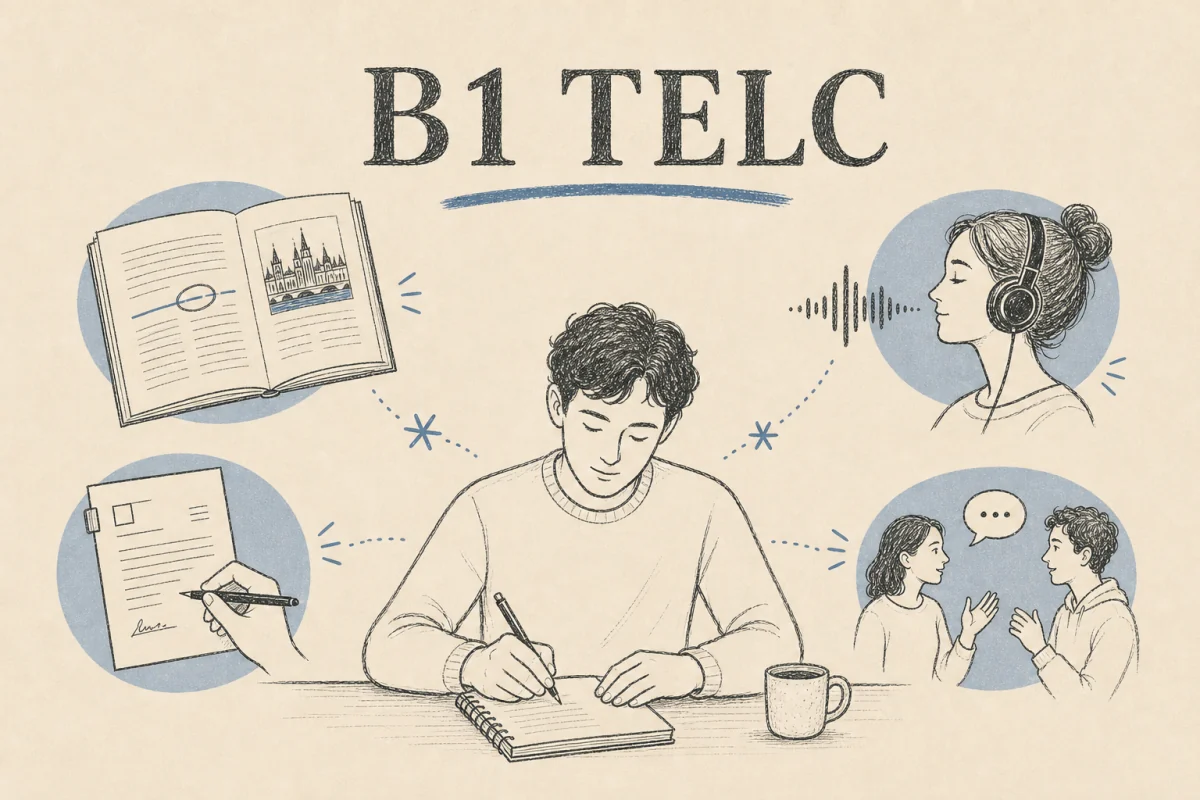
What if the hardest part of the TELC B1 exam is not the German? I have sat this exam myself, and after reading through dozens of first-person accounts from candidates who took it between 2023 and 2026 (on Reddit, on Medium, in forum threads and video comments), I kept arriving at the same uncomfortable conclusion: the exam candidates prepare for and the exam they actually sit are, in important ways, two different exams. I can confirm this personally. Almost everything that surprised those candidates surprised me too, sometimes point by point, and almost nothing I had feared in advance turned out to be the real problem. More on that below, in the sections where it belongs.
In this guide, we map that gap section by section, and build a preparation plan that targets the exam as it really is, not as the Modelltest suggests it will be.
The Fear Map: What You Dread vs. What Actually Sinks You
Consider your preparation energy as a budget. Every hour spent rehearsing for a threat that never materializes is an hour not spent on the one that does. Candidate accounts show, with remarkable consistency, that this budget is being misallocated.
Candidates overwhelmingly dread the speaking exam. What actually fails them, far more often, is listening and reading. One candidate who had lived in Germany for nine years confessed to being "super nervous about the listening part," and this from someone functionally fluent. Another achieved a perfect 75/75 in speaking and still failed the exam, scoring 35/75 in Lesen and 45/75 in Hören. Their productive skills were flawless; their receptive skills collapsed under exam conditions.
I misallocated the same way, so let me offer myself as one more data point. In the weeks before my exam I had a private tutor, and I spoke German with him every second day, because in my head the speaking part was the exam. All that anxiety, all that preparation, aimed at one section. Then the exam day came, speaking went fine, and the parts that actually made me sweat were reading and listening, the two I had treated almost as formality. My case is not special, it is just the pattern repeating.
Why does this happen? The speaking exam, for all its social terror, comes with scaffolding: your partner's utterances buy you thinking time, and examiners are trained to encourage rather than intimidate. Listening and reading offer no such mercy. The audio plays at real speed, the wording is deliberately slippery, and there is no one across the table to give you a moment to breathe.
The lesson is not to ignore speaking. It is to stop letting speaking anxiety consume the preparation budget that Hören and Lesen actually require.
Hörverstehen: The Once-Only Trap
The listening section has three parts, and they are not played the same way. Teil 1 (short dialogues) plays twice. Teil 3 (a detailed conversation) plays twice. Teil 2, a radio broadcast and typically the part with the fastest speech and the least familiar vocabulary, plays exactly once.
For me personally, this was biggest surprise of the whole exam. I did not know it going in. I sat there waiting for the second playing of Teil 2, and it simply never came, and I had to answer from whatever my ear had caught the first and only time. It is a very specific kind of cold feeling, and I would prefer that you meet it in practice, not in the exam room.
This detail is chronically under-emphasized in prep materials, and it produces genuine shock on exam day. One candidate put it bluntly: "Das Schlimmste ist, dass dieser Teil überhaupt nicht wiederholt wird": "The worst part is, this part is not repeated at all." Another finished the reading section thirty minutes early, admitted to having "gotten little lazy," and fumbled Teil 2 precisely because their guard was down.
The damage is compounded by a conditioning problem: many practice tests and apps play all audio segments twice. If your practice environment always grants you a second chance, you will walk into the exam expecting one, and panic when it doesn't come.
What successful candidates actually did:
- Read all the questions before the audio starts, so you know what you're listening for.
- Use shorthand notation, like "Mo 17:30 Arzt" rather than full sentences, so writing doesn't cost you the next sentence.
- Watch for corrections. Speakers frequently revise themselves ("um 18 Uhr, nein, um 18:30"), and the first number mentioned is often a distractor.
- Train under once-only conditions. Deliberately play practice audio a single time and force yourself to answer. It will feel harsh. That is the point.
A practical aside on point 4, since Lingviko is the tool I know best: you can recreate the once-only condition there quite easily. Turn the transcript off, play the audio one single time, and answer from that. Do this regularly and your ear starts catching the subtleties, the corrections, the numbers hidden mid-sentence, the way the real exam demands. It is not glamorous training, but it is exactly the training I wish I had done more of.
Leseverstehen: Trickier Than Any Modelltest
Here is the second systematic surprise. Multiple candidates, independent of each other, at different test centers, in different years, report that the real reading section is harder than the official practice tests. One candidate who had completed over ten model tests found the real Lesen "trickier than any model tests I've done." Another summarized the experience: "TELC really knows how to trip you up with their wording."
I will be honest about my own reading section, because I think the honesty is useful here. On the first pass, I understood maybe 70% of the text. Not 100%, not 90%. And I did not have time to close that gap by re-reading, so I worked through the multiple-choice questions from that partial understanding, mostly by process of elimination: crossing out the answers that could not possibly be true rather than confidently confirming the one that was. It worked, in the end, but it is not comfortable way to work, and nobody had told me the exam might feel like that. The second-hardest exercise for me personally was Sprachbausteine Teil 2, the last reading exercise in that part; do not let its position at the end fool you into treating it as an afterthought.
The mechanism is worth understanding, because it changes how you should prepare. The trap is rarely vocabulary. It is paraphrase: answer choices that contain the same words as the text but mean something different, or "almost true" statements sharpened by absolute words like immer, nie, nur, alle. If your reading strategy is keyword-matching (scan for the word, tick the box), you are exactly the candidate these questions are designed to catch. Always check the full sentence meaning, not just a matching word.
Schreiben: The One Section Where a Template Genuinely Works
If Hören and Lesen are where candidates get ambushed, Schreiben is where disciplined preparation pays off most reliably. The task is a semi-formal letter or email addressing four mandatory content points (Leitpunkte) in roughly thirty minutes. And the scoring priorities are refreshingly clear:
- Cover all four points. This matters more than perfect grammar. An email with minor errors that covers everything will outscore a flawless email that misses a point. Physically tick off each Leitpunkt as you write it.
- Decide Sie or du in the first line, and stay consistent. Mixing registers, like "Liebe Anna" followed by "Könnten Sie mir bitte...", signals confusion and costs points.
- Structure it properly: Anrede, introduction, main body, closing, Grußformel.
- Signal B1 deliberately: use three or more connectors (zuerst, außerdem, deshalb) and at least one subordinate clause with weil, dass, or obwohl.
There was a moment, somewhere in the middle of my own preparation, when Schreiben stopped being frightening, and it came from a realization that sounds almost too simple to write down: nobody hands you a script, and nobody predetermines your answer. You are given enough time to put your own sentences together, to choose the sentences you actually want to write. The Leitpunkte tell you what to cover, never how. Which means you can steer every single point toward vocabulary and structures you already control. Once I understood that the raw material was mine to choose, I stopped trying to produce the "expected" German and started writing the German I actually own, and the writing became precise instead of panicked. If you take one mindset shift from me for this section, take this one.
Sprechen: The Partner Lottery
Now we come to the part of the exam that no amount of solo practice can fully prepare you for, and we mean that literally, as a structural fact, not as rhetoric.
The TELC B1 speaking exam is conducted in pairs. Your partner is assigned by the test center, often alphabetically or by registration order, and is, from your point of view, a lottery ticket. The candidate accounts describe partners who had lived in Germany since 2001 and were "busy showing off" their fluency; partners who "knew like 2 words"; partners who were "very shy and very quiet" and gave mostly yes/no answers; partners who derailed the conversation entirely.
The archetypes, and how to survive each of them:
| Partner Type | The Risk | Your Strategy |
| The Dominator | Talks over you; you can't get a word in | Interrupt politely and remind them it's a dialogue; one candidate did exactly this, and passed |
| The Silent One | You must carry the whole conversation alone | Ask follow-up questions; keep visibly trying to involve them |
| The Derailer | Drifts off-topic, shaking your confidence | Keep steering the conversation back to the task |
| The Matched One | Minimal; this is the good outcome | Engage normally |
Two facts should steady you. First, you are scored individually, not as a pair, and examiners can see who is driving the conversation. In one account, the examiners were visibly irritated by a dominating partner, not by the candidate he was talking over. Another candidate, saddled with a nearly silent partner, still scored 28/30 in the joint planning task by carrying the conversation while continuing to involve them. Second, the paradox: candidates fear a stronger partner, but the data suggests a silent or absent one is more damaging, because it forces you into an exhausting monologue.
And here I want to repeat, from my own experience, the same realization I described in the Schreiben section, because for speaking it matters even more. Nobody in that room hands you a script, and nobody predetermines what you must say. You have preparation time, and within the task you are free to choose the sentences you actually want to say, built from the structures you actually control. For weeks I had been imagining the speaking exam as an interrogation where the "correct" German would be demanded from me. The moment I understood that I choose my own raw material, that I can steer the conversation toward what I know how to express, the fear mostly dissolved, and on the day I spoke fluently in a way that surprised even me. The exam tests whether you can communicate, not whether you can reproduce someone else's sentences.
Three more speaking tactics worth stealing: ask "Du oder Sie?" at the very start and stick to the answer; prepare for a wide topic range in the joint planning task: one candidate had rehearsed parties, trips, and fundraisers, and was asked to plan a class presentation; and use your preparation time to write keyword notes and sentence starters, not scripts. You cannot read a script in a dialogue anyway.
An Honest Word About AI Practice, Including Ours
Lingviko is an AI-based platform, so let me name the elephant directly rather than talk around it.
There is real evidence that AI practice tools can mislead exam candidates. Academic research has found that large language models grade German writing more generously than human examiners, deviating by almost a full grade upward in one study. Candidates report AI feedback that was confidently wrong, apps whose reading sections were "very easy as compared to what I got in the telc exam," and, most painfully, "weeks of app practice" that produced false confidence rather than readiness. AI grading can also err in the other direction: one candidate's AI grader was far harsher than the real examiners, who awarded 79/100 on a section the AI had all but failed.
We have put utmost care into matching the CEFR levels precisely, but replicating the exact exam you'll take is, as you know, impossible. I think the honest framing is this: AI practice is a volume and conditioning tool, not an oracle. It is excellent for drilling once-only listening, timed reading under paraphrase-heavy wording, and template-based writing at high repetition, the very areas where the exam ambushes people. It is not a substitute for a human partner in the speaking exam, because no AI conversation replicates the lottery of a real, unpredictable stranger. Whatever tool you use, including Lingviko, treat any "readiness" signal as a hypothesis, calibrate it against official Modelltests, and then assume the real exam will still be a notch harder, because candidates consistently report that it is, especially in Hören. And find at least one human speaking partner before exam day. Ideally an unpredictable one.
The Logistics Prep Materials Never Mention
A handful of administrative facts cause outsized stress, so let us put them in one place.
- The 60% threshold is doubled. You need 60% in the written part (135/225) and 60% in the oral part (45/75) separately. A strong written score cannot compensate for a weak speaking score, or vice versa.
- Partial retakes exist, with a trap. If you pass one part and fail the other, you can retake only the failed part within 12 months. But you must request the crediting when you register for the retake, not after results arrive. Candidates who miss this pay the full exam fee again.
- Results take longer than advertised. Official guidance says 4–6 weeks; candidate experience clusters at the 6-week end and sometimes beyond. If a residence permit or job start depends on the certificate, build in margin.
- The digital exam locks you out. In the digital format, once the listening section starts, you can no longer return to reading. Finish reading first. (The digital format can return results faster, but availability is limited; paper remains the default at most centers.)
One more thing from my own exam day, because no prep material warned me about it. My TELC B1 day ran from 8 in the morning until almost 2 in the afternoon. Shuffling between classrooms, waiting, waiting some more, then the pairing of candidates for the speaking exam in front of the commission. It was genuinely exhausting, not because of one sharp moment of difficulty, but as a long, low-grade mental drain that slowly eats your concentration. So my advice, earned the hard way: sleep well the night before, and mentally prepare yourself for a long day, not for a short test. The candidate who is still fresh at hour five has a real advantage over the one who spent the night cramming Sprachbausteine.
Conclusion: Prepare for the Exam As It Is
The candidates who pass TELC B1 with high scores share a recognizable profile. They memorized a Schreiben template and ticked off every Leitpunkt. They practiced under timers. They found real human partners to speak with, cooperative and uncooperative alike. And above all, they walked into the exam expecting the listening and reading to be harder than their practice tests, so that when they were, it registered as confirmation rather than catastrophe.
The candidates who fail, or barely scrape through, tend to over-prepare for grammar and speaking nerves while under-preparing for the once-only radio broadcast, the paraphrase traps in Lesen, and the sheer unpredictability of a paired dialogue with a stranger. I was very nearly the second kind of candidate, saved mostly by luck and by elimination strategy, and I would not recommend relying on either. The gap between practice and reality is real, it is documented, and, once you know where it lies, it is entirely trainable. That is what preparation should mean: not accumulating a comfortable score on an easy Modelltest, but closing the specific gaps the real exam will test.
Frequently Asked Questions
Is the TELC B1 harder than the official Modelltest?
In two sections, consistently yes. Candidates across multiple years and test centers report that the real Lesen and Hören are noticeably harder than practice tests, one candidate who completed over ten model tests still found the real reading "trickier than any" of them. The Sprachbausteine grammar section, by contrast, is usually described as manageable and close to Modelltest difficulty. Calibrate your expectations accordingly: a comfortable Modelltest score will likely translate to a lower real-exam score.
How many times is the listening audio played?
Teil 1 (short dialogues) and Teil 3 (a detailed conversation) are each played twice. Teil 2, the radio broadcast, is played once only, and it is typically the fastest and hardest part. Train for it under once-only conditions, because many practice materials play everything twice and condition the wrong expectation.
What happens if I get a bad speaking partner?
You are scored individually, not as a pair, and examiners can tell who is driving the conversation. If your partner dominates, interrupt politely and remind them it's a dialogue, candidates who did this still passed. If your partner is silent, ask follow-up questions and carry the conversation while visibly trying to involve them; one candidate did exactly that and scored 28/30 on the joint task. A difficult partner is a handicap to manage, not a death sentence.
What is the pass mark for TELC B1?
You need 60% in both parts separately: at least 135/225 in the written part (reading, listening, grammar, writing) and at least 45/75 in the oral exam. One cannot compensate for the other. If you fail only one part, you can retake just that part within 12 months, but you must request the crediting of your passed part when you register for the retake.
How long do TELC B1 results take?
Official guidance says 4–6 weeks. Candidate reports cluster at six weeks, and occasionally longer. If you need the certificate for a deadline, a residence permit, a job start, plan for the six-week end of the range. Digital-format exams can return results faster at some centers, but availability is limited.
Can I trust an AI app's "readiness" score?
Treat it as a hypothesis, not a verdict. Research shows AI graders can deviate from human examiners by almost a full grade, usually upward, occasionally in the harsh direction, and candidates have reported passing app-based practice easily only to be surprised by the real exam. Use AI practice for what it does well: high-volume drilling of listening, reading, and templated writing under time pressure. Verify with official Modelltests, assume the real exam will be a notch harder, and practice speaking with a real human partner before exam day.